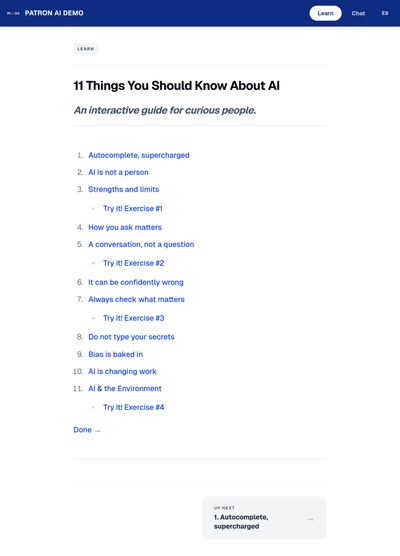
This spring, Highland Township Public Library became the first library to run a PLAID3 Hub pilot from start to finish. Over about two months, an invited group of patrons, staff, and board members tried the guided AI chat and the 11-lesson literacy curriculum. Here's what happened — the parts that worked, and the parts that didn't.
How it started
Highland came to us through the interest form in early April. Two of the library's staff had already been through our Library of Michigan AI cohort, so the team knew the shape of the work. From there it moved quickly: a demo in mid-April, board approval on May 5, and a live Hub instance by May 11.
Two early decisions shaped the whole pilot. First, the management team kept it invite-only — a selected group rather than an open public launch — while the library finished its staff AI policy. Second, we stood up a dedicated instance at highland.plaid3.com rather than sharing our demo site, so the usage data would reflect real patrons and nothing else. Both choices traded reach for caution and a cleaner signal. For a first pilot, that was the right call.
What patrons actually did
Once codes went out — about 25 to start, roughly 40 by mid-June — the most encouraging thing was how ordinary the use was. A staff member passed along what one patron stopped her to say:
She asked it for book recommendations based on books she has read and liked. She thought the list given was accurate and helpful. She was most impressed though when she asked for a knitting pattern and she got some good ones.
— Highland library staff member, relaying a patron
Book recommendations, then knitting patterns. That's exactly the "safe first step into AI" the Hub is meant to be.
The curriculum landed even harder than the chat. One patron worked all the way through it:
I spent about three hours (in two separate sessions) completing the 11 Step interactive guide. I learned a lot, took many notes, and would recommend this guide to everyone. The step by step directions were clear and the opportunities to use personal examples were helpful.
— Highland pilot patron
Others singled out the same things — the plain-language explanation of what AI is and isn't, the honest caveats about accuracy, and the "try it yourself" examples:
I went through the tutorial last night. I think it’s a great introduction to AI for new users, especially the caveats about accuracy and using it as a friend.
— Highland pilot patron
A board member — by her own account, not one to jump on the AI train unprompted — found the lessons genuinely helpful.
What worked
- The literacy program did its job with no staff facilitation. People completed it on their own and came away more confident.
- The privacy-first model held. No logs to manage, no accounts to reset, nothing to breach — and the board got aggregate numbers without ever seeing a patron's conversation.
- Low IT overhead was real. The heaviest lift was a logo that rendered too small, which we fixed by enlarging the template's logo space.
What didn't (and what we're changing)
The most useful findings were the frictions.
The first actual complaint was one we didn't expect: the coaching layer nudged patrons back to a librarian, which surprised a librarian. One staff member put it plainly — it kept telling her to go ask a librarian, and it was "very flattering," which put her off as a first-time AI user. The irony is that this is a feature: keeping the human librarian in the loop is a core design goal. But there's a real difference between routing a genuinely blocked query to staff and reminding a curious patron, mid-conversation, that they should really go ask someone.
Timing worked against us. The pilot's most active weeks overlapped with summer reading, when staff attention and patron traffic both went elsewhere. A July e-newsletter with a QR code widened the invite, but the lesson is clear: schedule a pilot around the library's calendar, not ours.
Distribution was stickier than expected. Handing someone an access code doesn't mean they'll use it — by mid-June, plenty of codes were out but untried, and a couple of invitations bounced from Comcast addresses. Future pilots need a lighter path from "here's a code" to "I'm chatting," plus a nudge or two for people who haven't started. Other libraries have discussed using the app and curriculum as an in-class learning resource, led by an instructor.
We also heard the harder no's honestly: a couple of staff declined to participate on environmental and social-impact grounds. We'd rather surface that than paper over it — those concerns are real, and they're part of the same conversation the Hub exists to support.
The takeaway
Highland was the only library among our spring group to carry a pilot all the way through; others postponed past summer reading or chose to wait for the paid release. That alone tells us something about readiness and timing. But where the pilot ran, the core bet held up: patrons who'd never touched AI used it for real, ordinary tasks and came away more literate — and their library never had to surveil them to prove it.