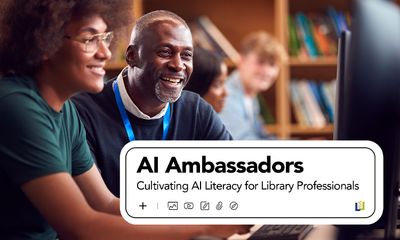
We just wrapped another round of AI Ambassadors, the training series LibraryLinkNJ runs in partnership with the LibraryLinkNJ Technology Advisory Group (L-TAG). I've had the privilege of leading this program since the first cohort launched in October 2023, and coming back to it in 2026 was a useful reminder of just how fast this field moves — and how much the role of library staff in it has changed.
This post is a recap of what we actually delivered across the series, what we were trying to accomplish, and what the experience taught us about teaching AI to the people who, in turn, teach everyone else.
Two and a half years is a long time in AI
The most striking thing about coming back to this material in 2026 was the distance we'd traveled since 2023. The sophistication of the tools between those two cohorts is genuinely memorable. What we were demonstrating in late 2023 as novel and a little experimental had, by this round, become capable, fast, and in many cases unrecognizably better.
The people in the room had changed too. Most of our 2026 attendees came in with a lot more hands-on experience using these tools in their actual work. We weren't introducing AI to a room of newcomers anymore. We were working with library staff who had already been using these tools, formed opinions about them, and run into real questions that don't have tidy answers. That shifted the whole center of gravity of the series — away from "here's what a large language model is" and toward "here's how to use this responsibly, explain it clearly, and help your community make sense of it."
What "Ambassador" actually means
The framing of the whole program is right there in the name, and it's not decorative. An ambassador isn't just someone who knows how to use a tool. An ambassador is someone responsible for translating.
Every attendee comes into this series with an expectation attached: they're going to take what they learn and deliver training to their own peers or patrons. That responsibility is the organizing principle of everything we do. It means it isn't enough to understand how AI works — you have to be able to take a genuinely complicated, fast-moving technology and explain it in plain language that anyone can understand, while making it relevant to the specific person in front of you.
That's a high bar, and it's a different skill than technical fluency. Plenty of people can use a tool well and still struggle to teach it. So a lot of the series is really about building that translation muscle: taking abstract concepts and grounding them in language and examples that land.
Context, skills, and experience — not a canned deck
This is the philosophy I'd most want anyone to take away from how we run this.
We deliberately do not hand attendees a finished slide deck and send them off to read it aloud. A canned presentation would undercut the entire point of the ambassador model. Every library is different, every patron base is different, and a one-size-fits-all deck would force ambassadors to deliver someone else's framing rather than their own.
Instead, our focus is on providing three things: context, so people understand the landscape and the stakes; skills, so they can actually operate the tools and reason about them; and experience, so they've worked through the material themselves and can speak to it with real confidence. What they build on top of that is theirs.
Building our own sandboxes — and why
A clear theme this round was appetite. Participants wanted more hands-on tool examples, demonstrations, and sandboxes — somewhere to actually try things rather than watch someone else drive.
So we stood up our own environment for them. We provided an OpenWebUI instance for chatting with large language models, and a separate AI image generation studio app for creating pictures. People could experiment directly: compare how models responded, test their prompts, generate images, and generally get their hands dirty in a low-stakes space.
We always provide our own tools rather than just pointing people at the big commercial services, and the reason matters. Some attendees can't use commercial AI tools at all — either because their library's policy prohibits it, or because they have personal, philosophical objections to those platforms. If we built the entire hands-on experience around tools a chunk of the room couldn't or wouldn't use, we'd be leaving people out of the most valuable part of the series. Running our own environment also lets us make the experience as privacy-respecting as possible, which is the right default when you're teaching people who serve the public.
Week 3: letting the questions drive
By the third session, we let the attendees set the agenda. The session was built around the questions and how-to requests we'd collected from the group, which meant we ranged across a lot of miscellaneous topics. But two areas pulled enough demand that we did real deep dives on them.
Teaching patrons AI literacy
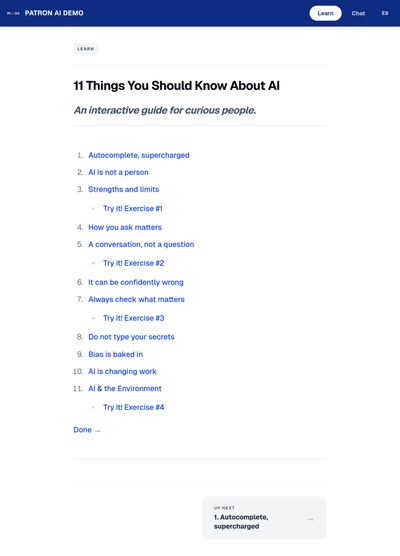
The first deep dive was on how to actually train patrons in AI literacy. If a library worker asks me what the single most important thing is here, my answer is: relevance.
The training has to be as relevant to each individual attendee as possible. Abstract explanations of how the technology works don't move people. Showing someone how AI can help them with the things they already care about — their work, their education, their hobbies, whatever brought them through the door — is what makes it click. The job of the ambassador is to find that connection for each person and build the lesson around it.
Writing an AI policy for a library
The second deep dive was on creating an AI policy for a library, which is exactly the kind of practical, slightly daunting task that staff need help with.
To tackle it, we walked through something I think is a genuinely useful approach. Shortly before the session, I'd used Claude Code to perform an automated, agentic analysis of existing public library AI policies and synthesize an ideal one — and in the session we reviewed that analysis together. Rather than starting from a blank page, the tool had worked through real policies that libraries had already published, identified what they had in common and where they diverged, and pulled all of that into a synthesized model policy. Walking the group through the result was a nice illustration of using AI not just as a chatbot but as a research assistant doing real work — and of the kind of task that's a perfect fit for these tools.
Closing in person at Piscataway
The series wrapped with an in-person meetup at the Piscataway Public Library in New Jersey. I joined that one remotely, but the purpose of the gathering was clear: it was working time. Attendees used it to develop their own plans and strategies for the ambassadorial activities they'd be taking back to their libraries — turning everything from the previous sessions into a concrete approach for their own communities.
That's the whole arc of the program in miniature. We give people context, skills, and experience over the course of the series, and then we give them space to figure out what to do with it. The deck, the lesson, the policy, the patron training — those belong to them.
Looking ahead
What started in October 2023 as an introduction to artificial intelligence has become an ongoing effort to support library staff as leaders in this space. The tools will keep getting more capable, and the questions will keep getting harder. But the core of the work hasn't changed: helping library professionals translate a fast-moving technology into something clear, relevant, and trustworthy for the people they serve.
AI Ambassadors is presented by LibraryLinkNJ in partnership with L-TAG, and led by Jim Craner of The Galecia Group.